
The Upward Spiral of Window Craft
- Steve Quillian

- Jan 26
- 6 min read

Why This Trade Has No Ceiling — and Doesn’t Require a Shop
I took a photo recently of a house in San Antonio that quietly says everything about what Window Craft really is.
At first glance, it just looks like a handsome historic façade. But if you actually look at it the way an artisan reads a job, you see something deeper:
Two small oval windows flanking the front door.
A lace-like transom over the entry.
Normal 6-over-6 and 8-over-8 double-hung windows above.
And gothic arched windows up in the attic that I personally remade for this same client.
All of that complexity — simple and advanced — living on one single house.
And what it shows, better than any theory ever could, is this:
Window Craft has an upward spiral of growth.
And it never caps out.
Not just for artisans.
Not just for craftsmen.
But for leaders, managers, and builders too.
The Bread‑and‑Butter Windows That Pay Everybody
Let’s start with something people consistently miss.
The 1‑over‑1s.
The 2‑over‑2s.
The 6‑over‑6s.
The straight‑line double‑hung windows.
These are not “beginner junk.”
They are the economic engine of the trade.
They’re the rhythm windows.
They’re the momentum windows.

They’re the production windows.
They’re the morale windows.
They’re the ones where:
You find your cadence
Your sequencing gets clean
Your movements get efficient
Your judgment sharpens
Your timing stabilizes
Your team locks into flow
And practically speaking:
Those are the windows that pay everybody.
They fund the operation.
They keep the crew moving.
They subsidize the edge cases.
They carry the weight of the business.
So when we talk about upward mobility, it’s important this never sounds like:
“Double hungs are entry‑level junk you rush through to get to the real stuff.”
Because the truth is the opposite:
Double hungs are the foundation that makes everything else possible.
Where the Spiral Actually Starts: The Total Window Makeover

The upward spiral of Window Craft doesn’t start with a “basic window.”
It starts with something deeper:
The Total Window Makeover is not a style of window.
It’s a course in mastery of movements.
It forces a person to:
Touch all Five Pillars
Sequence all Five Pillars
Feel the interaction between sash, frame, and mechanics
Understand why order matters
See cause‑and‑effect across phases
Learn what breaks when you cheat steps
It introduces:

Mechanics to Primed Frame (M2P)
Stripped to Glazed Sash (S2G)
Glazed to Finished Sash (G2F)
Primed to Finished Frame (P2F)
Assembled and Tuned (A&T)
And it does something more important than just “teach a window.”
It trains transferable judgment.
Once someone has internalized a Total Window Makeover, they don’t just “know double hungs.”
They now possess:
A sequencing framework
A diagnostic logic• A performance‑first mindset
A repeatable order of operations
Which means the upward spiral always starts in the same place:
Total Window Makeover → Five Pillars → Mastered Movements
The First Spiral: Craft Growth
When people talk about “advancing in a trade,” they usually mean getting faster at the same narrow thing.
Window Craft is different.
Once the basic movements are mastered, those same movements can be reapplied to:

More complex sash
More complex frames
More complex geometry
More complex mechanics
Not perfectly to every window.
But broadly to most of them.
The Five Pillars don’t make you omnipotent.
They make you structurally competent.
Which means a person can:
Stay in the bread‑and‑butter lane
Or move into harder geometry
Or master one‑off historic problems
Or become the person who handles the edge cases
And none of those are inferior paths.
This is a trade that keeps opening upward.
It does not flatten people into one destiny.
Not Everyone Is Cut Out for the Craft Spiral — and That’s Not a Failure
Here’s the missing half of the picture.
Not everyone is wired to:
Chase ever‑harder geometry
Master curved joinery
Build complex sash
Live at the technical edge of difficulty
Some people are.
Some people aren’t.
And trying to force everyone into the same artisanal destiny is exactly how you lose good people who do have a calling — just not that one.
Window Craft doesn’t have one upward spiral.
It has two.
The Second Spiral: Leadership and Business Mastery
This spiral starts in the same place:
The Total Window Makeover.

Because:
You cannot lead what you do not understand.
Everyone who leads must:
Touch the Five Pillars
Learn the sequencing
Feel the timing
Understand bottlenecks
See how sash and frame converge
This creates shared reality and common language.
The First Leadership Threshold: Becoming “Team Leader”
There’s a moment when someone stops being “a worker” and becomes:
The one who sees the whole job.
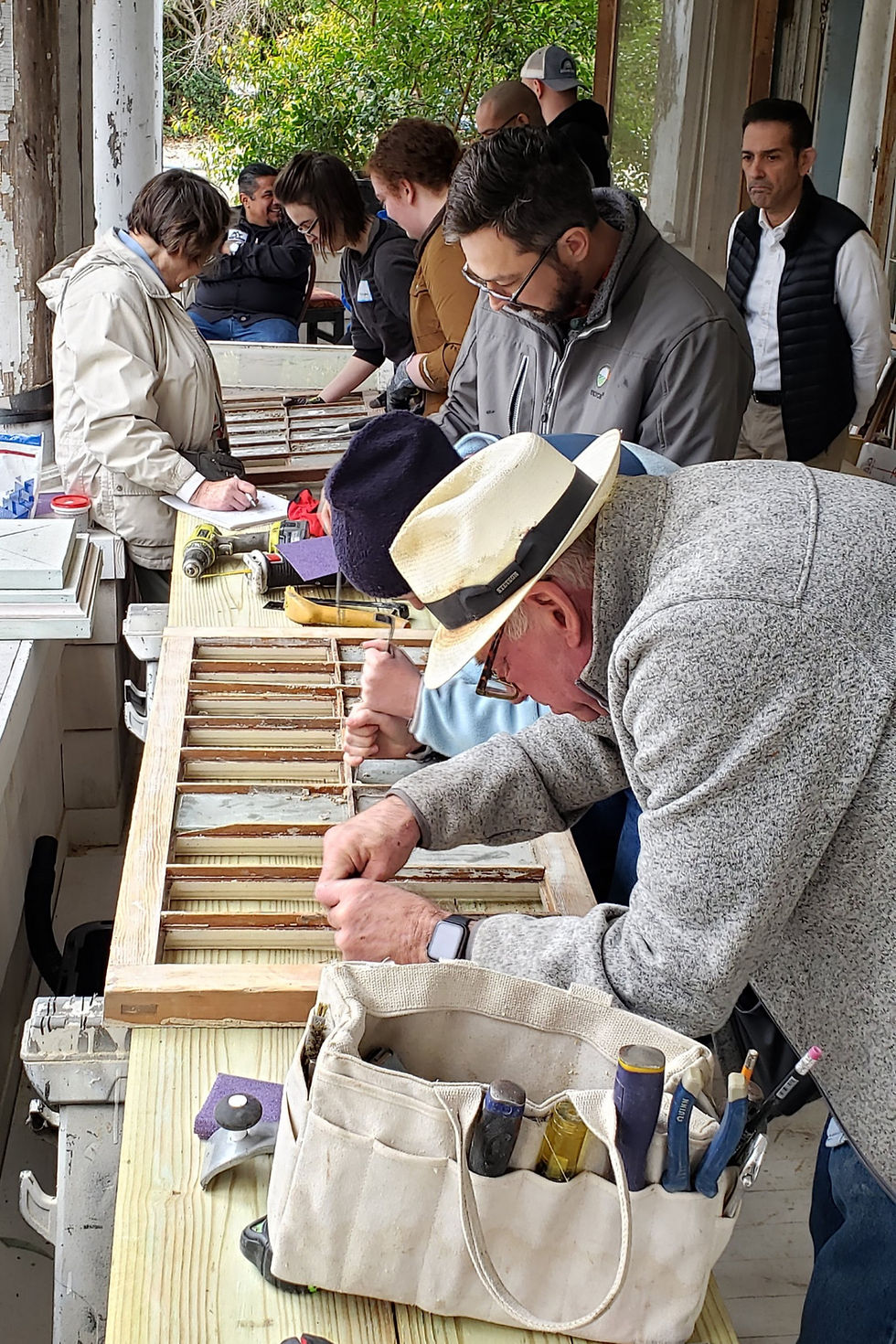
That person understands:
M2P timing
S2G pacing
G2F bottlenecks
P2F dependencies
A&T convergence
When sash and frame must arrive together
What breaks sequencing
That person is the Team Leader.
Not a boss.
Not a micromanager.
But:
The embodied sequencing intelligence of the Five Pillars.
The Second Leadership Threshold: Scaling a Crew
Once someone can:
Keep one frame person and one sash person in rhythm
Maintain momentum
Prevent bottlenecks
Preserve quality
Deliver predictable outcomes
The spiral turns.
Now you add:
A second frame person
A second sash person
Now you’re managing:
A four‑person Window Craft engine.
This is where leadership becomes real.
Because now:
Communication complexity doubles
Error propagation doubles
Sequencing pressure doubles
If they can master that:
They can manage any crew size.
The Third Threshold: Running Two Jobs at Once
Now the spiral turns again.
Two crews.
Two houses.
Two timelines.
Two chaos fields.
Now they’re learning:
Scheduling
Resource allocation
Quality drift control
Leadership delegation
Cash‑flow timing
This is no longer a craft problem.
This is a business problem.
And it is every bit as deep as technical mastery.
The Shopless, Scalable Reality
Here’s one of the most important things about this whole model.
It does not require a shop.

You can have a shop.
But you don’t need one.
This system works with:
Three‑person teams (carpenter, finisher, manager)
Mobile work
Low overhead
On‑site sequencing
Client‑funded projects
Which means someone can:
Stay a tight three‑person team
Fly below the radar
Undercut larger companies
Do better work
Move faster
Maintain total control
Or they can:
• Run two crews
• Run three crews
• Run multiple jobs
• Control a local territory
And none of it requires becoming a giant company.
None of it requires leaving the trade behind.
Two Legitimate Callings Inside One Trade
This is what makes Window Craft structurally different from most trades.
It doesn’t flatten people into one destiny.

It creates:
A Craft Spiral
A Leadership Spiral
Some people climb one.
Some people climb the other.
Some hybridize both.
And none of them are inferior paths.
Which means:
Window Craft doesn’t just produce artisans.
It produces leaders, operators, and founders.
Why the Spiral Is Truly Never‑Ending
The Craft Spiral never ends.
There is always:
Harder geometry
Deeper joinery
More complex restoration
More demanding problems
The Business Spiral never ends.
There is always:
Another crew
Another job
Another territory
Another outpost
Both start with:
The Total Window Makeover.
The Five Pillars.
Sequenced Movements.
Both reward:
Judgment
Mastery
Attention
Leadership
So the final truth becomes this:
There is upward mobility in Window Craft for every kind of calling.
For the craftsman.
For the leader.
For the manager.
For the builder.
For the founder.
And it never caps out.
What That San Antonio House Really Shows
Those small oval windows aren’t decorative details.
They’re the top rung of a ladder.
That ladder starts with:
One window
One Total Window Makeover
One sequence of mastered movements
And it rises into:
Crews
Territories
Outposts
Lifelong mastery
All living together on one façade.
Final Word
Window Craft is not just a trade.

It is:
A craft ladder
A leadership ladder
A business ladder
A life ladder
All built on the same foundation:
The Total Window Makeover + The Five Pillars + Sequenced Movements.
Which means:
Some people will master harder joinery.
Some people will master crews.
Some people will master territories.
Some people will master outposts.
All of them are legitimate.
All of them are honorable.
All of them are necessary.
And none of them require leaving Window Craft behind.
Where This Path Actually Starts

If any part of this upward spiral resonates with you — whether the craft side, the leadership side, or the business side — it always starts in the same place:
The Total Window Makeover.
That’s why the upcoming workshops in Uvalde, Texas exist.
They’re not just classes.
They’re the on‑ramp into this entire framework.
They introduce the Five Pillars, the sequencing logic, the shared language, and the real‑world rhythm of Window Craft as a living system — not a theoretical trade.
For some people, Uvalde will be a one‑time learning experience.
For others, it will be the first step into a much larger calling.
Either way, if this article felt like it was describing a path you’ve been looking for but couldn’t name, the Total Window Makeover in Uvalde is where that path becomes tangible.


Comments