
The Mechanics of the Vineyard

Why a Window Craft Team Is Three People
Most window restoration shops unknowingly lose about three hours of productivity every day before real work even begins.
It happens quietly. The crew reports to the shop, loads tools, drives across town, unloads, sets up, and only then does the work start. At the end of the day the whole process runs in reverse.
When I finally did the math on it years ago, I realized that a three-person crew was losing nearly nine billable labor hours every single day. Over the course of a year that inefficiency adds up to roughly $50,000 in lost productivity.
That realization forced me to rethink how window restoration should actually work.
The surprising answer didn’t come from business theory.
It came from the window itself.
For many years we ran window restoration the way most shops do it.
The crew showed up at the shop around eight in the morning. Tools were loaded into the truck, the plan for the day was discussed, and then everyone piled into the company vehicle and headed to the job site.
If everything went smoothly we might leave by 8:30.
Then we’d drive across town. When we arrived, the real work still hadn’t started.
Tools had to come off the truck. Work areas had to be set up. Protection had to be laid down so we didn’t damage the client’s home. Ladders, cords, lights, and everything else needed to actually begin.
By the time all that was finished it was usually around 9:30.
Sometimes closer to ten.
That means a three-person crew might be on the clock for an hour and a half before anyone even touched a window.
At the end of the day the same thing happened in reverse. Work had to stop early enough to break everything down, load the truck, and drive back to the shop.
When I finally sat down and did the math on it, something became impossible to ignore.
We were paying about three hours of non-productive time every single day.
Not three hours for the crew.
Three hours per person.
Three people times three hours equals nine labor hours per day that can never be billed to a client.
But you still have to pay for them.
You pay wages.
You pay payroll taxes.
You pay workers’ compensation.
You pay insurance.
You pay for the truck, the fuel, and the maintenance.
When I multiplied that number out across a year it came out somewhere around fifty thousand dollars.
Fifty thousand dollars disappearing every year simply because the workflow itself was inefficient.
Stretch that across ten years and you’re looking at something like half a million dollars.
Employees rarely notice this kind of thing. To them it’s just part of the day. But if you’re responsible for keeping the business alive, you start to notice where the money leaks out.
That realization pushed me to rethink how the work should actually happen.
But the deeper answer didn’t come from business math.
It came from the window itself.
The Window Is the Teacher
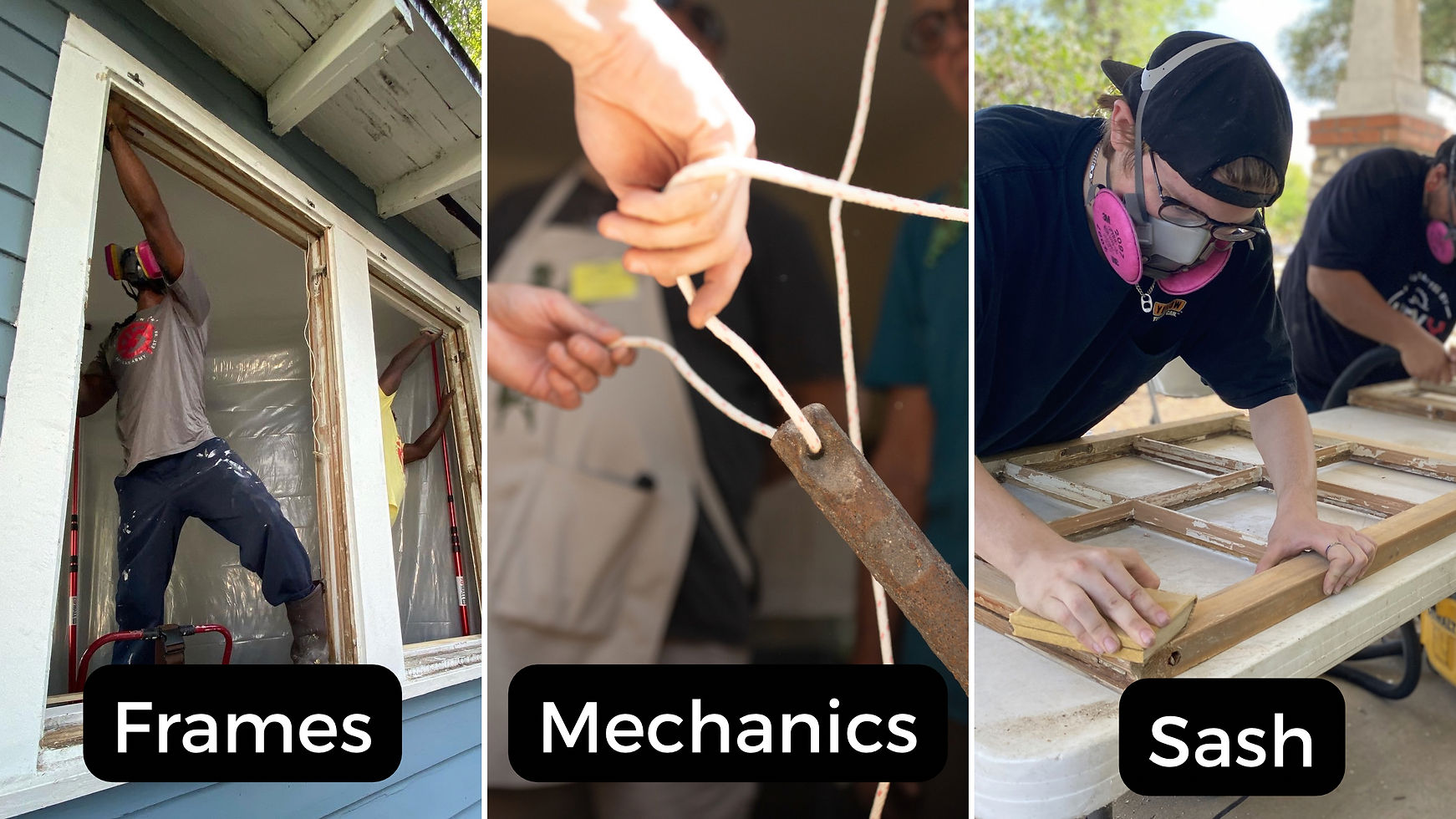
Every window has three basic elements.
There is the frame, which attaches to the building.
There is the sash, which holds the glass.
And there are the mechanics.
Most people think of mechanics as ropes, pulleys, hinges, or cranks. Those things certainly matter. But mechanics really describe something deeper.
Mechanics describe the relationship between the sash and the frame.
Without that relationship the window doesn’t function.
You could have a perfectly restored sash. You could have a beautifully repaired frame. But if those two things don’t relate to each other properly, the window still won’t work.
Once I started thinking about the window this way, something else became clear.
Two Kinds of Work
In Window Craft there are really only two kinds of work.
There is frame work.
And there is sash work.
Frame work deals with the structure attached to the building. That includes carpentry, repairing sills, rebuilding jambs, tuning tracks, and making sure the opening itself functions correctly.
Sash work deals with the movable parts. That includes stripping paint, repairing wood, priming, glazing, and finishing.
Those two disciplines account for almost everything that happens during a window restoration.
But there is still a third element required for the system to function.
Someone has to maintain the relationship between the two streams of work.
The Manager Is the Mechanics
In a Window Craft team the manager becomes the mechanics of the system.
Just as the pulleys and weights inside a window balance the sash against the frame, the manager balances the work between the frame artisan and the sash artisan.
The manager watches the flow.
Is the sash ready when the frame is ready?
Is the frame tuned before the sash gets painted?
Is the work happening in the right sequence?
Is momentum being maintained?
Without that balancing force, the system loses rhythm.
You might still have good carpentry. You might still have beautiful glazing. But the work becomes slow and disorganized.
That is why a Window Craft team naturally settles into three people.
One person working the frame.
One person working the sash.
And one person maintaining the relationship between them.
The mechanics of the window appear again in the mechanics of the team.
When the Press Begins to Turn
Once those three roles are in place something interesting happens.
The work begins to move in cycles instead of straight lines.
While the frame artisan is working through Mechanics to Primed Frame, the sash artisan is already stripping and preparing the sash.
While glazing cures, frame work continues.
While paint dries, the next window begins its first stage.
Instead of waiting around for one step to finish before starting the next, the whole system begins to move.
The work flows.
And when the flow is healthy, a three-person team naturally settles into a rhythm of about one window per day, or roughly five windows per week.
Not because someone set a quota.
Because that’s the pace where the system stays balanced.
The Wine Press
Over time I began describing the Five Pillars of Window Craft as a wine press.
The image comes from the parable of the vineyard.
In that story the landowner plants a vineyard, builds a wall around it, digs a wine press, and builds a tower before entrusting the vineyard to workers.
Each of those pieces has a purpose.
The vineyard produces fruit.
The wall protects the territory.
The wine press transforms the fruit into something valuable.
The tower provides oversight.
Historic house communities across the country are full of windows waiting for attention.
The Five Pillars of Window Craft form the press that transforms those neglected windows back into functioning pieces of architecture.
And the artisans become the workers who operate the press.
The press doesn’t store grapes.
It processes them.
And when the press is running properly, the work keeps moving.
Frame.
Sash.
Assembly.
Tune.
The press keeps turning.
The Vineyard Doesn’t Lie
One lesson the vineyard teaches is simple.
The vineyard doesn’t lie.
Either the workers produce fruit or they don’t.
You can talk about craftsmanship all day long. You can debate techniques and write articles and attend conferences.
But in the end the vineyard tells the truth.
Windows either get restored.
Or they don’t.
The press either turns.
Or it sits still.
Window Craft exists to keep the press turning.


Comments